Start with the room, not the bed
A bed can fit within a room’s dimensions and still make the room awkward to use. Before choosing its position, measure the usable floor area and sketch the locations of doors, windows, closets, outlets, vents and fixed features. Mark the direction in which each door opens. Then note where you naturally walk: from the entrance to the bed, from the bed to the closet and around any dresser or chair.
Measure the full footprint of the bed you intend to use, including the frame, headboard and any footboard. A frame may extend beyond the mattress, and an upholstered headboard may need space behind it for its shape or for access to an outlet. Include bedside tables in the sketch rather than treating them as pieces to squeeze in later. This gives you a more useful picture than comparing the mattress dimensions with the room dimensions alone.
Use clearances as planning guides
For many bedrooms, roughly 24 inches of open floor beside a bed is a useful starting point for a passage. Around 30 inches may feel less cramped when someone needs to turn, make the bed or pass a piece of furniture. These are planning guides, not guarantees that a layout will work for everyone. Measure the actual route, and allow more space where the room’s users or their belongings require it.
Check the foot of the bed separately. If it faces a wall with no furniture, you may need only enough room to walk through comfortably. If it faces a dresser, account for the space taken by open drawers and by someone standing in front of them. The same principle applies to closet doors, storage benches and bed frames with pull-out drawers. A generous-looking gap can disappear when something opens into it.
A clearance is most useful when it remains clear in daily life. A floor lamp, laundry basket or chair pulled away from a desk can narrow a route. If space is tight, plan for the room as it is normally used, not only as it looks when every item is put away.
Choose the placement that protects key routes
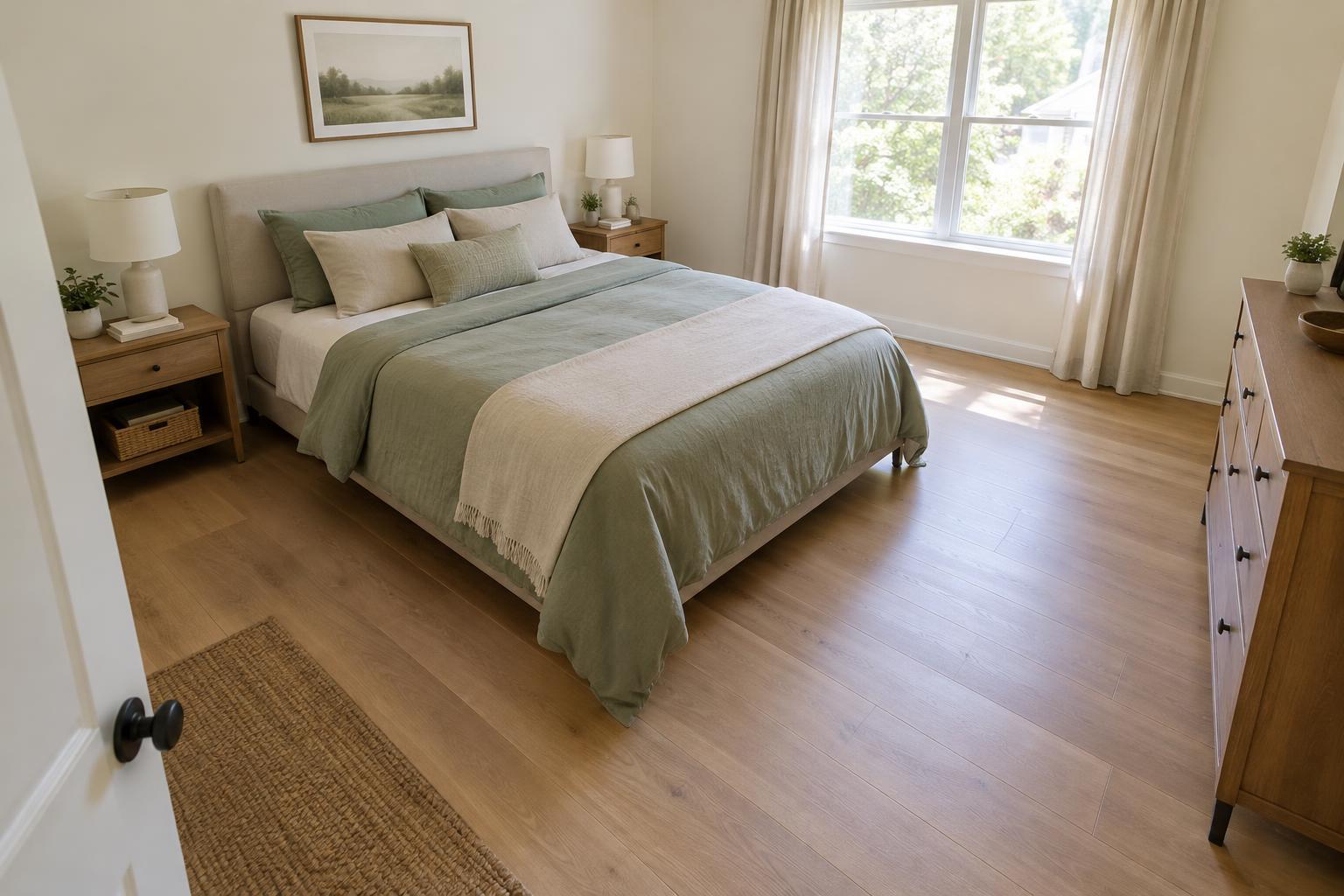
Placing the head of the bed against a solid wall often creates a simple layout and leaves the center of the room easy to understand. If two people use the bed, access on both sides can make getting in, changing sheets and reaching bedside items easier. In a narrow room, however, putting one side against a wall may preserve a better route to the door or closet. That trade-off can be reasonable if the person using the wall side is comfortable with it.
A bed centered beneath a window may be the best fit in some rooms, but check practical details first. Can the window still be opened and cleaned? Will a headboard block a vent or interfere with curtains? Similarly, a bed placed near a doorway should not obstruct the door’s swing or turn the entrance into a tight corner. Give priority to unobstructed exits and the routes you use most often rather than to visual symmetry alone.
Test the layout before moving everything
Use painter’s tape or sheets of paper to mark the bed and other large furniture on the floor. Walk the routes you sketched, imagining drawers and doors in their open positions. If possible, set a chair where a bedside table would go. This simple trial can reveal whether a corner is uncomfortable to pass or whether a table is hard to reach from the mattress.
Consider the tasks that need room around the bed. Can you stand at the sides to change the sheets? Can you reach an outlet without stretching behind heavy furniture? Is there a place to set down a book or glass without filling the walkway? When a layout falls short, changing to a slimmer bedside shelf, a frame without a projecting footboard or a different dresser position may help more than shifting the bed by a few inches.
Make comfort and access the final check
The best placement is not necessarily the one with equal space on every side. It is the one that lets the people using the bedroom move through it and carry out ordinary tasks with little effort. Keep frequently used storage easy to reach, avoid leaving cords across walking paths and choose furniture sizes that leave the important routes open.
Once the furniture is in place, walk through the room again at different points in your routine, including when the bed is made and storage is open. If you repeatedly turn sideways or move an object out of the way, treat that as useful feedback. A small adjustment to the layout can make a bedroom feel easier to use without changing the bed itself.