Start with the light you need to block
A bedroom window can admit direct sunlight, street lighting or light from a hallway. Before choosing a covering, notice where the light enters and when it bothers you. A bright band around the window calls for a different fix than light passing through the fabric itself.
“Blackout” generally describes material designed to block light from passing through it. It does not guarantee a dark room once the covering is installed. Light can still enter above, below or beside it. The window’s shape, the mounting position and the fit may matter as much as the material.
Blackout curtains: broad coverage with a soft look
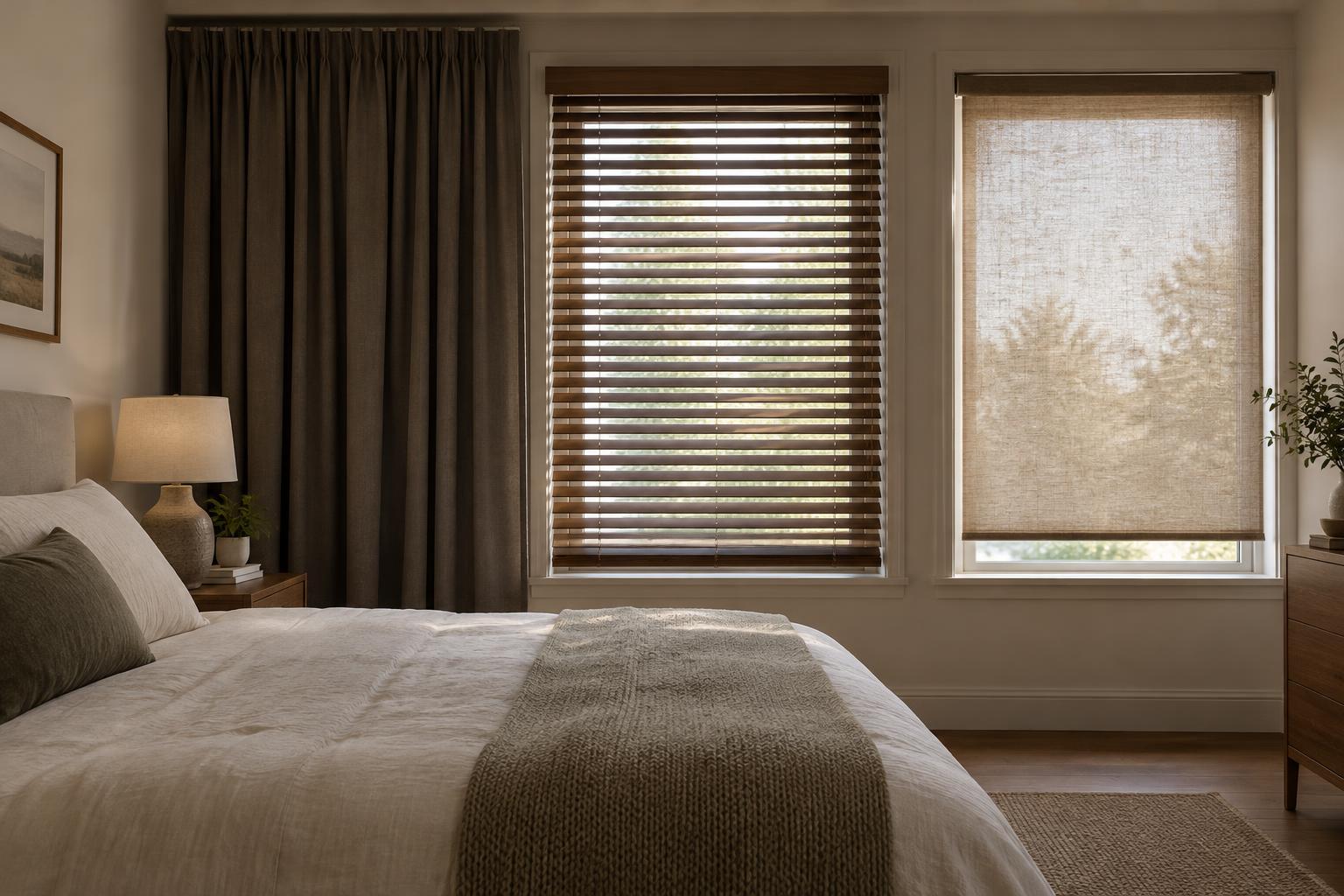
Blackout curtains are a useful choice when you want to cover the window and some of the surrounding wall. A rod mounted above and beyond the window frame gives the panels room to overlap the edges. Panels that reach close to the floor can also reduce light entering at the bottom. Measure the intended coverage area rather than ordering only by the glass dimensions.
Curtains can soften the look of a bedroom and offer many choices of color and texture. Their folds, however, may let light through at the center opening or where the panels meet the wall. A wraparound rod can help at the sides, while enough panel width allows the curtains to overlap at the middle. Check care labels before buying: some panels can be washed at home, while others need more careful cleaning.
Blinds: adjustable light, less complete darkness
Blinds have slats that tilt, so they are convenient when you want daylight or privacy without fully uncovering the window. That adjustability is their main advantage over a solid blackout panel. Even when the slats are closed, though, light may pass through the spaces between them, around their edges or through cord holes in some designs.
Blinds make sense when daytime control matters more than maximum darkness. They can also sit beneath curtains, giving you adjustable light by day and fuller coverage at night or in the morning. Their slats tend to collect dust, so consider whether you will find them easy to wipe down. If children may use the room, look for a cordless design or another option that avoids accessible operating cords.
Shades: a tidy fit with different levels of control
Shades raise and lower as a single covering rather than tilting like blinds. A blackout roller shade has a simple profile and can sit close to the window. Cellular and Roman shades offer different textures and shapes, and some are available with blackout material. Check the specific fabric: a shade’s style alone does not tell you how much light will pass through it.
An inside-mounted shade keeps the window trim visible but usually needs clearance to operate, leaving potential gaps along the sides. An outside mount can extend beyond the frame and cover more of those gaps. Some roller shades can be paired with side channels for closer edge coverage, though suitability depends on the window and the installation. As with blinds, a cordless operating option is worth considering where accessible cords would be a concern.
Choose by fit, daily use and the room’s look
For the darkest practical setup, start by planning how the covering will overlap the frame. Blackout curtains on a wide, high-mounted rod or an outside-mounted blackout shade can cover more than a closely fitted inside mount. If edge light still bothers you, combining a shade with curtains gives you a second layer. No covering can compensate for a bright light source elsewhere in the room, so check doorways and electronics too.
Think about how often you open the window or adjust the covering. Blinds offer fine control through the day; shades are quick to raise and lower; curtains are easy to sweep aside but need wall space to stack. Take measurements in more than one place, check for handles and radiators that could interfere, and follow the manufacturer’s mounting and clearance guidance.
The best choice is not necessarily one product. Choose the level of darkness you need, then balance it against cleaning, ease of use and the appearance you want. A neat shade may suit a compact window, while curtains may work better when you want to frame it as part of the bedroom’s design.