Start with the job you want it to do
A portable air purifier pulls room air through a filter and sends it back out. In a bedroom, its most useful job is usually capturing airborne particles such as dust, pollen and some fine particles from smoke. It cannot clean every surface, remove a source of pollution or replace fresh-air ventilation. If dust gathers on bedding and floors, regular cleaning still matters.
Think about the room before comparing models. Note its floor area, ceiling height and whether the door is usually open or closed. Also consider when you expect to run the purifier. A model that performs well only at a speed too loud for sleep may be less useful to you than one you can comfortably leave running overnight.
Match cleaning capacity to the bedroom
Product listings often give a recommended room size, but that figure is most helpful when it also explains the assumed ceiling height and how often the room’s air is cleaned. A clearer comparison is the clean air delivery rate, or CADR, where one is provided. CADR describes how much filtered air a unit delivers for particular particle types. A higher rating generally means the purifier can clean a given room’s air more quickly at the speed used for that rating.
Measure your bedroom rather than relying on labels such as “large room.” If the ceiling is unusually high or the space opens into another room, allow more capacity than the floor area alone suggests. Compare like-for-like ratings where possible, and check whether a quoted room size reflects a useful cleaning rate or merely the largest space in which the manufacturer suggests using the unit. An adjustable model with capacity to spare may let you choose a quieter setting at night.
Understand what the filters can capture
For particles, look for a mechanical filter with a clearly stated specification, such as a true HEPA filter, rather than assuming that “HEPA-type” means the same thing. A pre-filter catches larger debris and can help protect the main filter; some pre-filters are washable, while others should only be vacuumed or replaced. Follow the instructions for the particular model, since washing a filter not designed for water can damage it.
Activated carbon can help with some odors, but its effectiveness depends in part on how much carbon the unit contains and how often it is replaced. A thin carbon sheet should not be assumed to handle persistent cooking smells, fumes or moisture problems. Remove the source of a smell when possible. If a bedroom feels stale, damp or musty, address ventilation or moisture as well; a purifier is not a substitute for fixing leaks or managing humidity.
Some purifiers add ionizers or other electronic features. If you prefer straightforward particle filtration, choose a model that does not use those features or lets you turn them off. Check the product documentation so you know what runs by default.
Choose a sound level you can sleep with
Noise figures need context. A decibel number may describe only the lowest fan speed, while the published cleaning capacity may be measured at a higher, louder speed. Look for sound information at multiple settings and read the controls carefully: a “sleep” mode may dim the lights and slow the fan, but it may also move less air. If possible, listen to the model before buying or choose a retailer with a practical return policy.
Consider the character of the sound as well as its volume. A steady airflow may be easier to ignore than a changing motor tone, a rattle or frequent automatic speed changes. Check whether display lights can be dimmed and whether button sounds can be disabled. Features that seem minor in a living room can be distracting beside a bed.
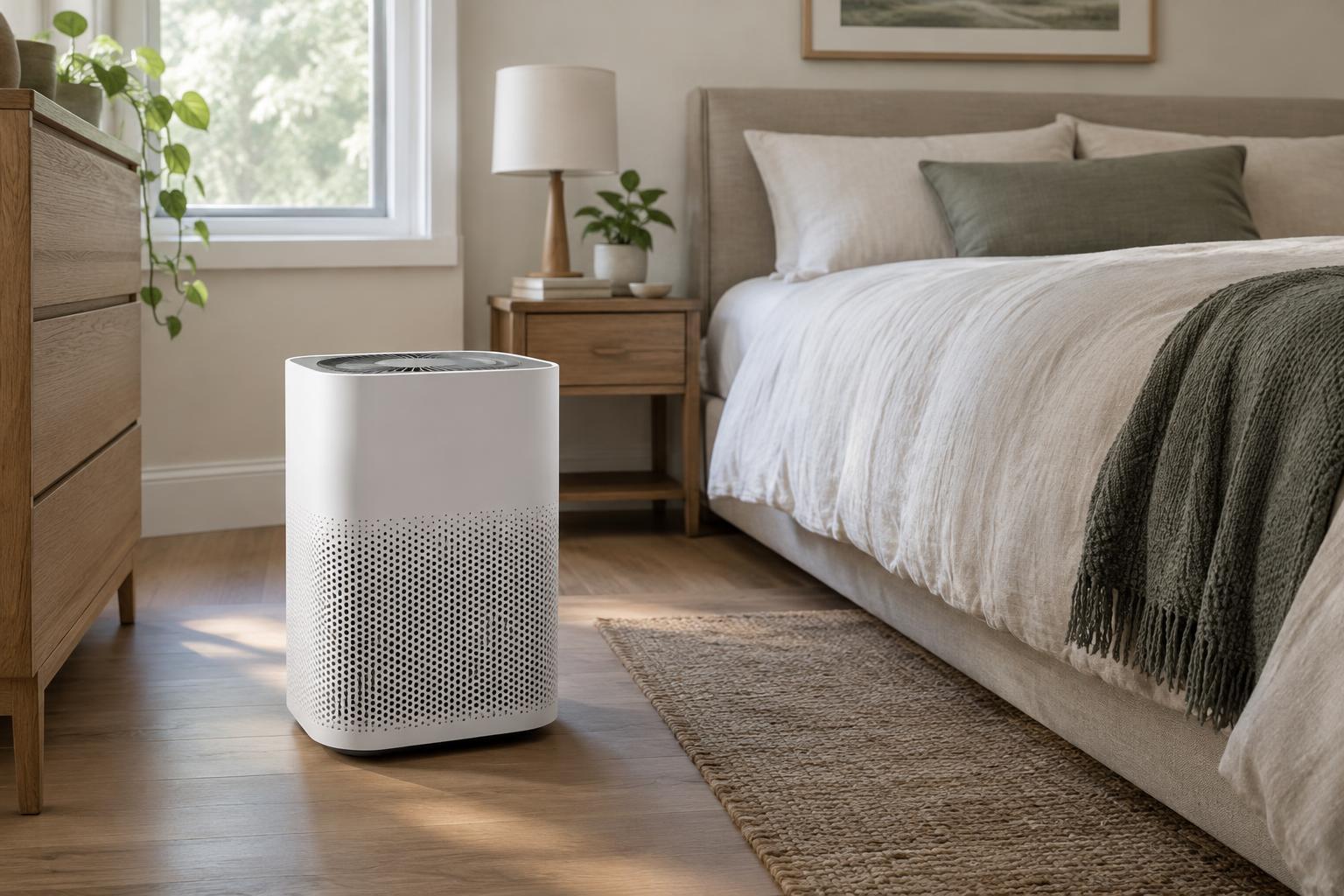
Give the unit room to work. Place it on a stable surface with its intake and outlet clear of curtains, bedding and furniture, using the clearances in the manual. Avoid putting it where airflow blows directly across your pillow if that feels uncomfortable.
Plan for upkeep before you buy
The purchase price is only part of the cost. Check the price and availability of replacement filters, the recommended replacement schedule and whether the unit uses one combined cartridge or separate particle and carbon filters. Those details affect what you will spend and how much flexibility you have. Filter-life indicators can be useful reminders, but inspect and replace filters according to the manufacturer’s guidance rather than treating an indicator as a measurement of air quality.
Keep the intake and pre-filter free of accumulated lint, and follow the manual when cleaning the housing. If you run the purifier with windows open, air from outdoors will continue entering the room; whether that is desirable depends on the conditions outside and your need for ventilation. The best bedroom choice is usually a unit sized for your space, quiet enough at a useful speed and simple enough to maintain consistently.