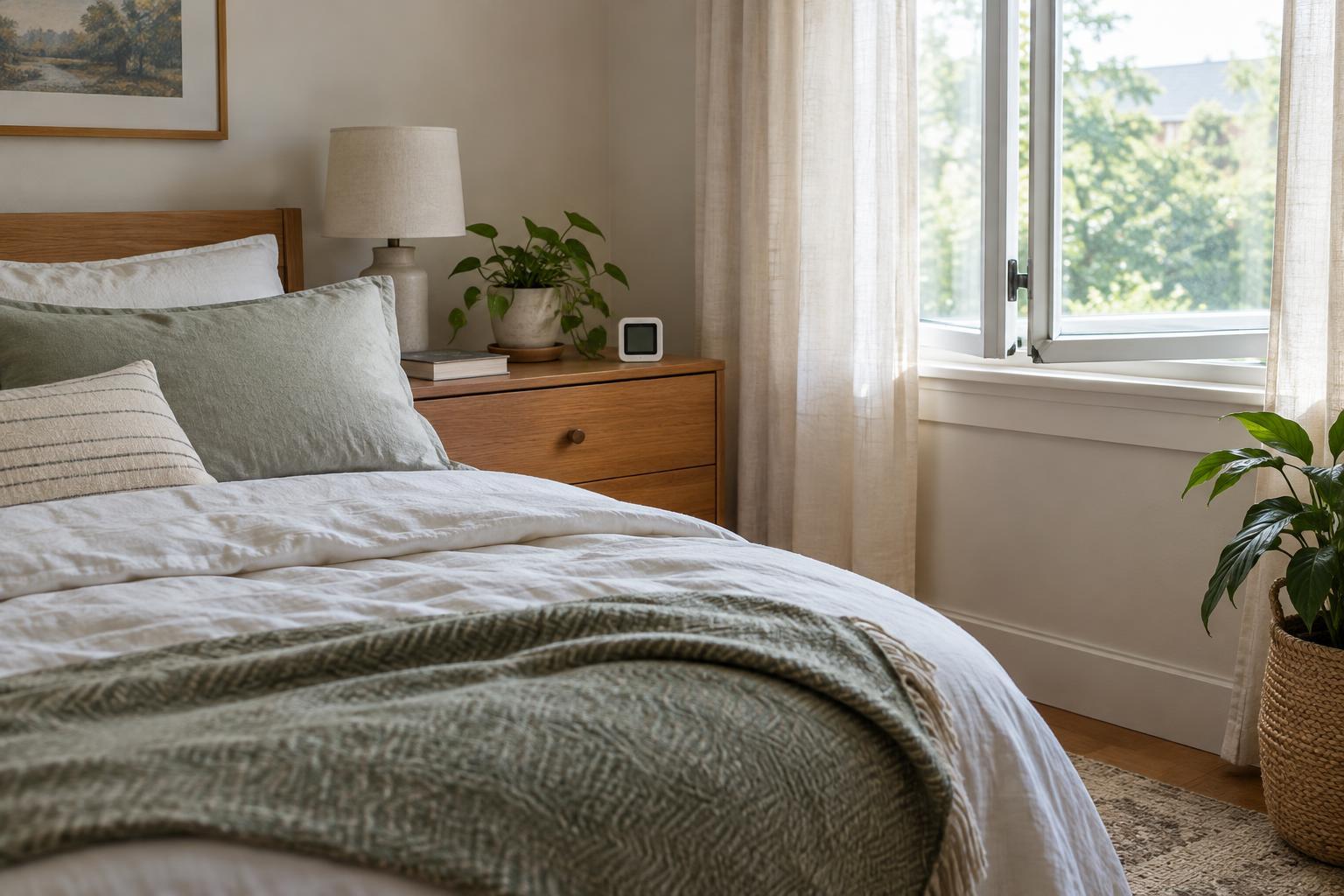
What bedroom humidity tells you
Humidity describes the amount of water vapor in the air. Most household humidity meters display relative humidity, or RH: a percentage that changes with temperature as well as moisture. A reading can rise when a room cools even if no new water has entered it. That is why one number, taken at one moment, rarely tells the whole story.
For many bedrooms, roughly 30% to 50% RH is a useful starting range. It is not a rule that every home can maintain year-round. In cold weather, moisture may condense on windows or other cool surfaces even when the meter reads within that range. At the other end, very dry air may feel uncomfortable, but adding moisture without checking for condensation can create a different problem. Use the reading alongside what you observe in the room.
Measure in a place that represents the room
A small digital hygrometer is a straightforward way to track bedroom humidity. Place it near sleeping height, away from a window, radiator, air vent, humidifier, or direct sunlight. Those spots can give a reading that reflects a local draft or temperature difference rather than the room as a whole. If the bedroom has a damp corner or a poorly ventilated closet, you can check those areas separately.
Give the meter time to settle after moving it, then note readings at different times for several days. Morning readings may differ from evening readings, especially if the door stays shut overnight. Write down the temperature too, if the device provides it. Consumer hygrometers can vary, so look for a repeated pattern rather than reacting to a change of a few percentage points. If a reading seems implausible, comparing it with a second meter can help.
Look for clues beyond the number
Persistent window condensation, a musty smell, damp-feeling fabrics, or visible discoloration can suggest that moisture is collecting somewhere. Check behind furniture placed against exterior walls and around window frames, where air movement may be limited. A moderate room reading does not rule out a damp patch on a colder surface or moisture from a leak.
Dry-feeling air may coincide with static in bedding or a dry sensation in the nose and throat, though humidity is not the only possible cause. Also consider room temperature, airflow, and whether heating is running. If you find recurring dampness, identify its source before relying on a dehumidifier alone. A leak, for example, needs attention even if a machine can lower the room’s RH.
Make small changes, then measure again
If humidity is often high, start by reducing avoidable moisture: vent bathrooms after showers, use kitchen extraction when cooking, and avoid drying wet laundry in the bedroom when possible. Check that vents are not blocked and allow some airflow around large furniture. Opening a window can help when outdoor air is suitable, but it is not always effective; warm, humid outdoor air may add moisture rather than remove it. A dehumidifier can help with persistent high RH if it is sized for the space and its water container or drain is maintained.
If humidity is consistently low, a humidifier may make the room feel more comfortable. Raise the setting gradually and watch for condensation, particularly during cold weather. Follow the appliance’s instructions for water, emptying, and cleaning: standing water and neglected components can create hygiene problems. Neither a humidifier nor a dehumidifier needs to run simply because the bedroom feels imperfect on one day.
Protect bedding and keep the routine simple
Mattresses, pillows, and bedding benefit from a chance to dry after use. Pull back the covers for a while after getting up, wash bedding according to its care labels, and make sure any washed item is fully dry before putting it back on the bed. Keep a mattress on a suitable, ventilated support as recommended by its maker. These habits cannot fix a damp room, but they can help prevent moisture from lingering in fabrics.
A practical routine is to check the hygrometer occasionally, pay attention to condensation or odors, and adjust one thing at a time. For example, improve bathroom ventilation and observe the bedroom for a few days before deciding whether additional equipment is needed. The aim is not to hold the meter at an exact percentage. It is to keep the room comfortable while avoiding persistent dampness and unnecessary moisture buildup.