Start with the layer diagram, not the comfort label
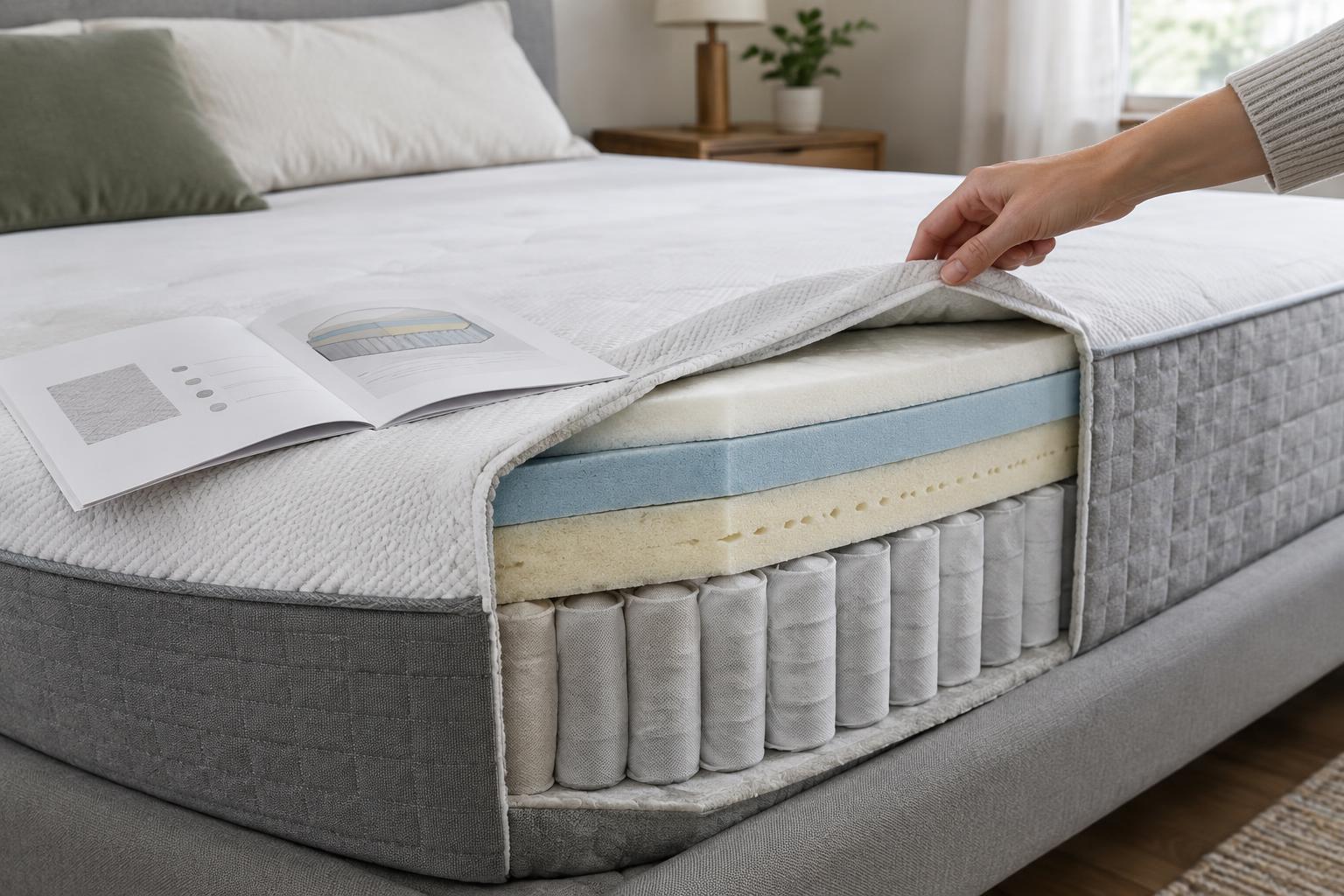
A mattress listing may call a bed plush, supportive, cooling, or luxurious. Those words describe an intended experience, but they do not tell you what is inside. Look first for a diagram or written breakdown that names the layers from the sleeping surface down to the base. Note the material and thickness of each layer, plus the total mattress height. If the listed layers do not add up to roughly the stated height, the difference may be in the cover or quilting—or the listing may be incomplete.
Pay particular attention to the top few inches. These comfort layers are closest to your body and often have the greatest effect on the initial feel. A thin soft layer over a firmer core is a different construction from several inches of soft foam, even if both beds carry the same firmness label. Firmness is also subjective, so use it as a starting point rather than a substitute for construction details.
Translate foam names into useful specifications
Product pages often use names such as memory foam, polyfoam, gel foam, or proprietary comfort foam. These describe broad categories or features, not a complete recipe. For each foam layer, try to find its thickness, its position in the mattress, and, where available, its density. Density describes how much material is packed into a given volume; it is not the same as firmness. A dense foam can be formulated to feel soft, while a less dense foam can feel firm.
Density can help you compare otherwise similar foam constructions, but it does not predict how long a whole mattress will last on its own. Layer thickness, foam formulation, body weight, and use all matter. If a listing gives a density without saying which layer it belongs to, ask for clarification. Likewise, terms such as “gel-infused” identify an ingredient or design choice; they do not establish that a mattress will feel cool throughout the night.
Check what supports the comfort layers
In a foam mattress, the lower support core is usually a thicker, firmer foam. Look for its material, thickness, and density rather than assuming that “high-density base” has a consistent meaning across brands. In a hybrid or innerspring mattress, check whether the listing identifies the coil type, coil height, coil count, and any reinforced edges or zones. A pocketed coil unit, for example, is constructed differently from a connected coil unit, but the coil label alone cannot tell you whether a particular bed will suit you.
Coil count is easiest to interpret when you also know the mattress size and coil design: a number presented without that context is a weak comparison tool. The same caution applies to zoning, which means that different areas are built to respond differently. Ask where the zones sit and how they are made. A zoned mattress is not automatically a better fit; its effect depends in part on your height, sleeping position, and where your body lands on the bed.
Read the cover and small-print materials list
The cover and quilting can change the feel of the surface. Check whether the cover is removable, whether it contains padding, and which materials are listed for the fabric and any fill. Do not assume a removable cover is machine-washable; follow the stated care instructions. If temperature comfort is important to you, look for concrete descriptions of fabric, fill, and airflow features rather than relying on a single “cooling” label.
Also check for adhesives, fire-barrier materials, and latex where the listing discloses them, particularly if you have a material preference or sensitivity. A certification may apply to a component rather than the entire finished mattress. Read what is certified and what the certification covers instead of treating a badge as a general promise about comfort, safety, or performance.
Compare what is disclosed—and ask about what is not
Make a short comparison sheet for each mattress: layer order and thicknesses, foam densities where provided, coil details, cover materials, and care requirements. Keep price, trial terms, return conditions, and warranty terms in separate columns. Those policies matter to a buying decision, but they do not reveal how the mattress is built. Confirm whether the construction details apply to your chosen size and model version.
If a key specification is missing, ask the seller a precise question, such as “What is the thickness and density of the top polyfoam layer?” A vague answer may leave you unable to make a meaningful comparison. Reading listings this way is an editorial comparison of disclosed specifications, not a hands-on test of comfort or durability. The goal is not to find a perfect number; it is to understand what you are buying, spot meaningful differences, and recognize where the available information runs out.