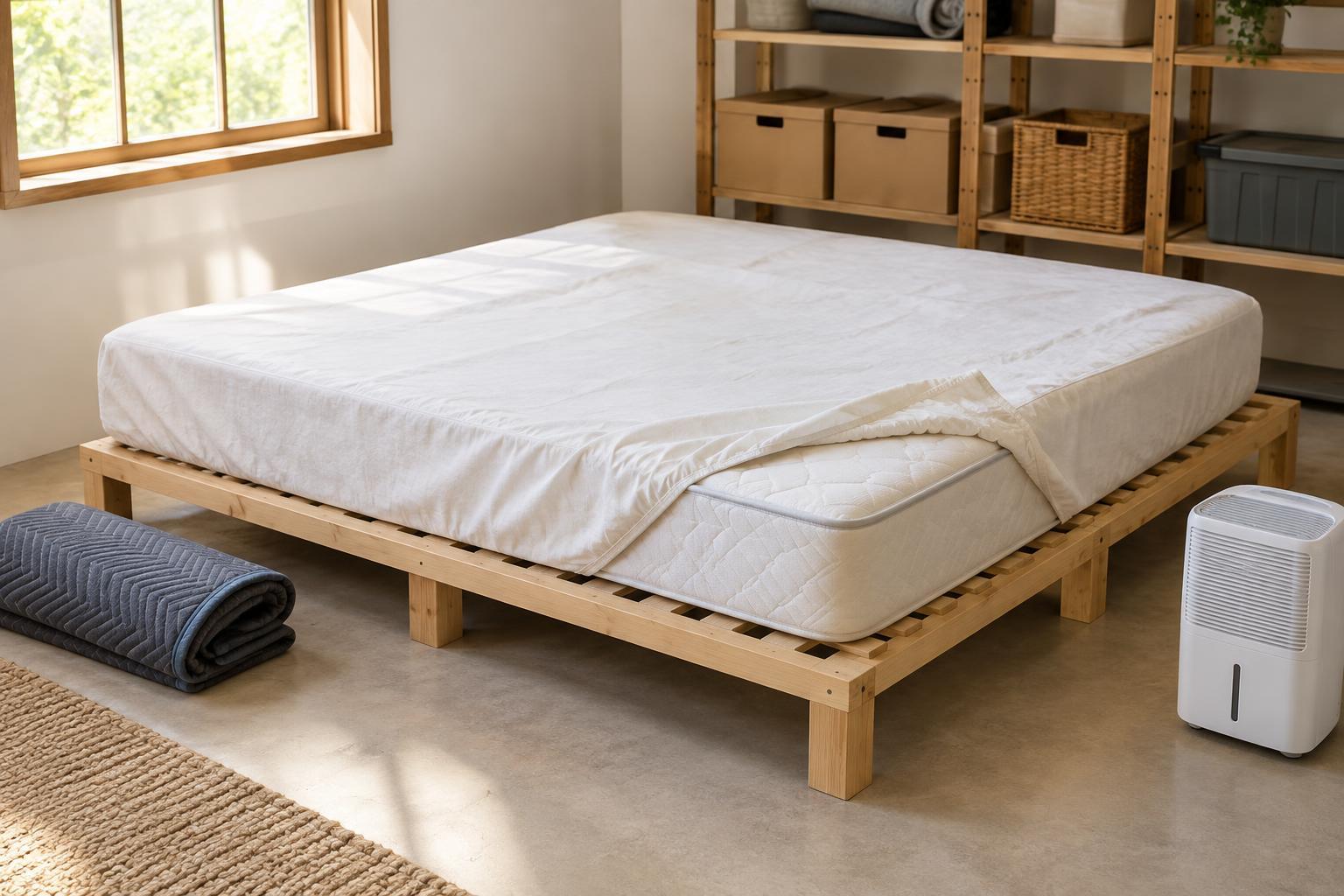
Check the mattress and plan its storage position
Before moving a mattress, check its care label or manufacturer guidance. Construction matters: a foam mattress, an innerspring mattress and a hybrid may have different limits on bending, rolling or standing upright. A mattress that arrived compressed in a box is not necessarily meant to be compressed again at home. Unless its instructions explicitly allow it, do not fold or tightly roll a mattress for storage.
Plan for a space large enough to keep the mattress flat and fully supported. A clean, rigid platform or closely spaced support surface helps prevent sections from hanging over an edge. If flat storage is impossible, check whether the manufacturer permits short-term upright storage. Place an upright mattress on its long edge against a stable wall, and avoid leaving it leaning at a sharp angle. The aim is to prevent its weight from distorting the layers over time.
Clean it, then let it dry completely
Remove all sheets, protectors and pads, and store those separately after laundering them according to their labels. Vacuum the mattress surface and seams with a clean upholstery attachment. If you need to address a spot, follow the mattress maker’s cleaning directions and use as little liquid as practical. Soaking the cover or inner layers can make the mattress difficult to dry.
Do not wrap the mattress immediately after cleaning. Give any treated area time to dry through, not just on the surface. Check for dampness, staining or a musty smell before proceeding. If the mattress has been exposed to significant water or shows signs of mold, covering it for storage is likely to make the problem harder to assess and may worsen it. Resolve the condition before deciding whether the mattress is suitable to keep.
Choose a cover that protects without concealing dampness
A mattress storage bag or clean cover can keep dust and handling marks off the bed. Choose one that fits without forcing the mattress to curl, and close it in a way that keeps dirt out during the move. Handle the cover gently: a torn bag offers little protection when a mattress brushes against a doorway or storage-room floor.
A cover does not make a damp mattress safe to store. In a humid space, tightly wrapping a mattress can also hold moisture against it if humidity or condensation gets inside. Start with a thoroughly dry mattress, then prioritize a dry, temperature-stable storage area over a perfectly sealed package. If you use plastic, inspect it for trapped moisture during longer storage; if your storage conditions are uncertain, a breathable cover may be preferable for dust protection. Keep the mattress raised off bare concrete or other surfaces that may become damp.
Move and place it without stressing the structure
Clear the route before lifting, including stairs, tight turns and low doorframes. Use enough people to control the mattress rather than forcing it around a corner. Carry it on its edge when needed for clearance, but avoid sharply bending it to fit a vehicle or doorway. Moving straps can help distribute the load; built-in side handles, where present, may be intended only for positioning rather than carrying the mattress’s full weight.
At the storage site, lay the mattress on its prepared support without heavy boxes or furniture on top. Concentrated weight can leave impressions or strain the edges. Keep it away from potential leaks and allow enough access to inspect the area. A dry indoor room is generally a better choice than a space with frequent condensation or large swings in humidity. If you must use a less controlled space, check it regularly rather than assuming the cover alone will protect the mattress.
Inspect it before bringing it back into use
When storage ends, remove the cover and examine both sides, the seams and the underside. Look for moisture, staining, pest activity or an unusual odor. Let a clean mattress air out in a dry room before making the bed, especially if it spent time in a protective bag. If you stored it upright with the maker’s permission, lay it flat and allow it to settle before judging its shape.
Storage cannot reverse existing wear, but careful preparation can help prevent avoidable damage. The simplest rule is to keep the mattress dry before covering it, supported while it rests and unbent while it moves. If its condition has changed noticeably, consult its care guidance before using cleaners or attempting to reshape it.