Start with the route, not the lamp
Before choosing a night-light, walk through the bedroom in daylight and identify the route you use after turning off the main light. It might run from the bed to a doorway, a bathroom or a child’s room. Notice where the route changes direction and where furniture legs, a rug edge or a door threshold could be hard to distinguish in the dark. A light placed along that route is often more useful than one that brightens the entire bedroom.
Keep the walking space clear even if you plan to add lighting. Move shoes and bags out of the path, make sure rugs lie flat and leave enough room around the bed to turn comfortably. Lighting can help you see an obstacle, but it is no substitute for removing it. If more than one person uses the room, check the route from both sides of the bed.
Choose a gentle light you can live with
For a bedroom, look for enough light to make the floor and nearby objects visible without shining directly into your eyes. A softly glowing, downward-facing fixture can illuminate a walkway while leaving the bed relatively dark. The right brightness depends on the room, your eyesight and how much other light enters through windows or doorways, so an adjustable night-light is useful when you are unsure.
Warm-toned light often feels less stark than a cool, bright beam. Shade and placement matter just as much as color: a bare point of light at mattress height may be distracting even when its output is low. If you can see the bulb from your pillow, try a shielded design or move the fixture below your direct line of sight. Avoid assuming that a product labeled “sleep-friendly” will suit everyone; the practical test is whether it lets you navigate comfortably while keeping the room pleasant for sleeping.
Match the controls to how you move
A steady plug-in night-light is simple: it is ready whenever you get up, and you do not have to find a switch. It may work well in a hallway or at an outlet near the bedroom door. In the sleeping area, however, even a small constant glow can be noticeable. A switch or adjustable brightness gives you more control.
Motion-activated path lights stay off until they detect movement, which may suit someone who prefers a darker room. Consider where the sensor points and whether it will respond before you reach an obstacle. A light that switches on when a partner rolls over, or that turns off while you are still walking, may be frustrating. Check whether its timing and sensitivity can be adjusted. Battery-powered or rechargeable lights allow flexible placement where outlets are scarce, but they need occasional charging or battery checks.
Place lights where they help, not where they glare
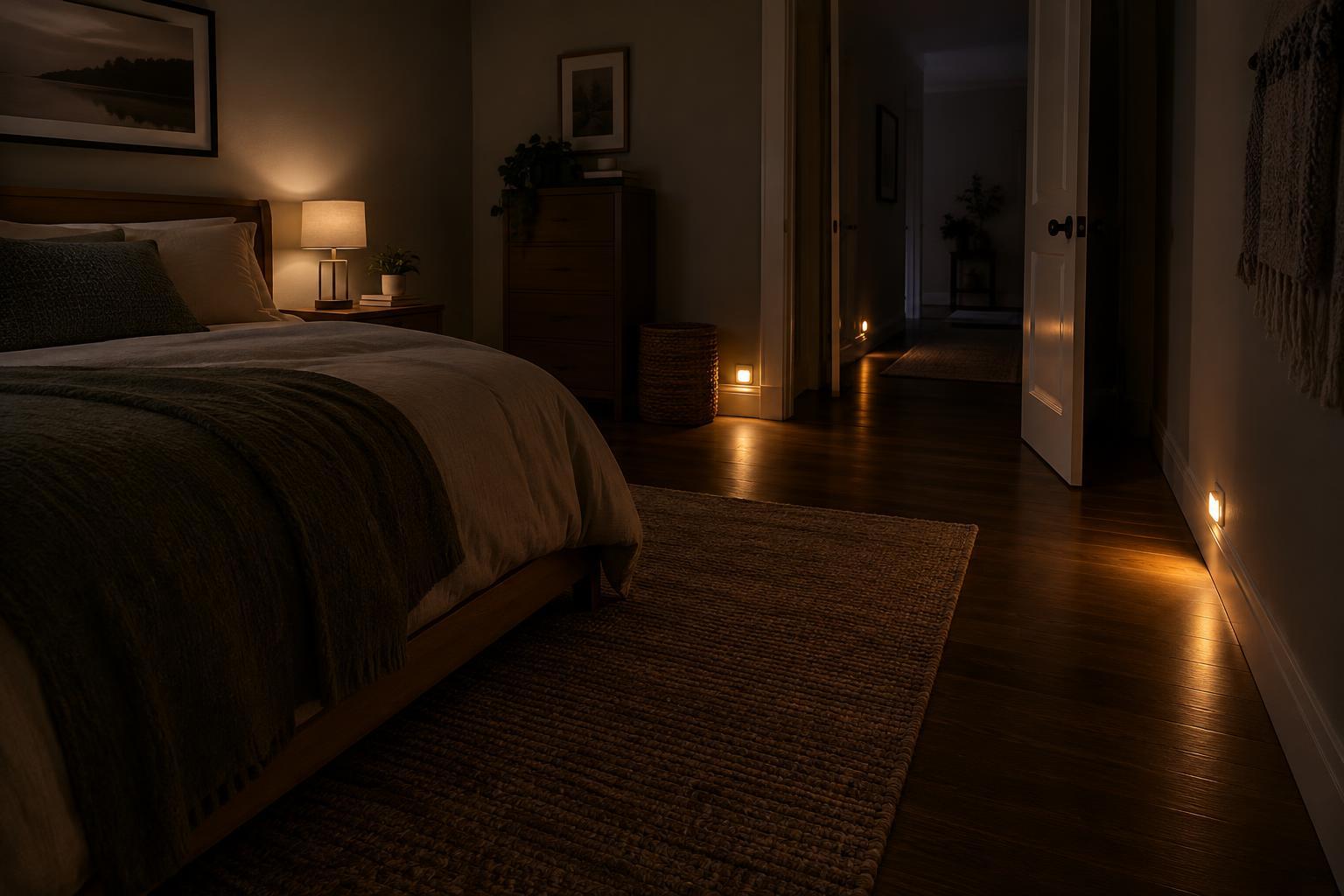
Position a light to reveal the floor ahead of you, especially near turns and doorways. Low-mounted lights can mark a route without illuminating the whole room, provided furniture does not block their beam. If one light leaves a dark gap between the bed and the door, two modest lights may be more comfortable than one bright lamp. A dim hallway light can also help you see beyond the bedroom doorway without lighting the bed itself.
Think about the fixture during the day, too. A plug-in light should not protrude into a narrow passage where it can be bumped. Keep cords out of walking areas, and use a fixture according to its instructions rather than running a cable under a rug or bedding. For a child’s room, choose a location and product suited to that room’s occupants, with batteries and small detachable parts kept out of reach where relevant.
Check the setup from bed to doorway
Once the lights are in place, try the route under the conditions in which you will use it. Sit up in bed and look for glare. Then stand, pause to let your eyes adjust and walk toward the door. Can you see the floor beside the bed, the edge of any furniture and the doorway without looking into a bright bulb? Repeat the check from the other side of the bed and from the doorway on the way back.
Make small adjustments rather than aiming for a perfectly illuminated room. Lower the brightness, change the angle or shift a light closer to a turn if needed. Revisit the setup when you move furniture, change bedding that may cover a low light, or notice that a battery-powered fixture has dimmed. The best path lighting is unobtrusive when you are resting and dependable when you need to move.